
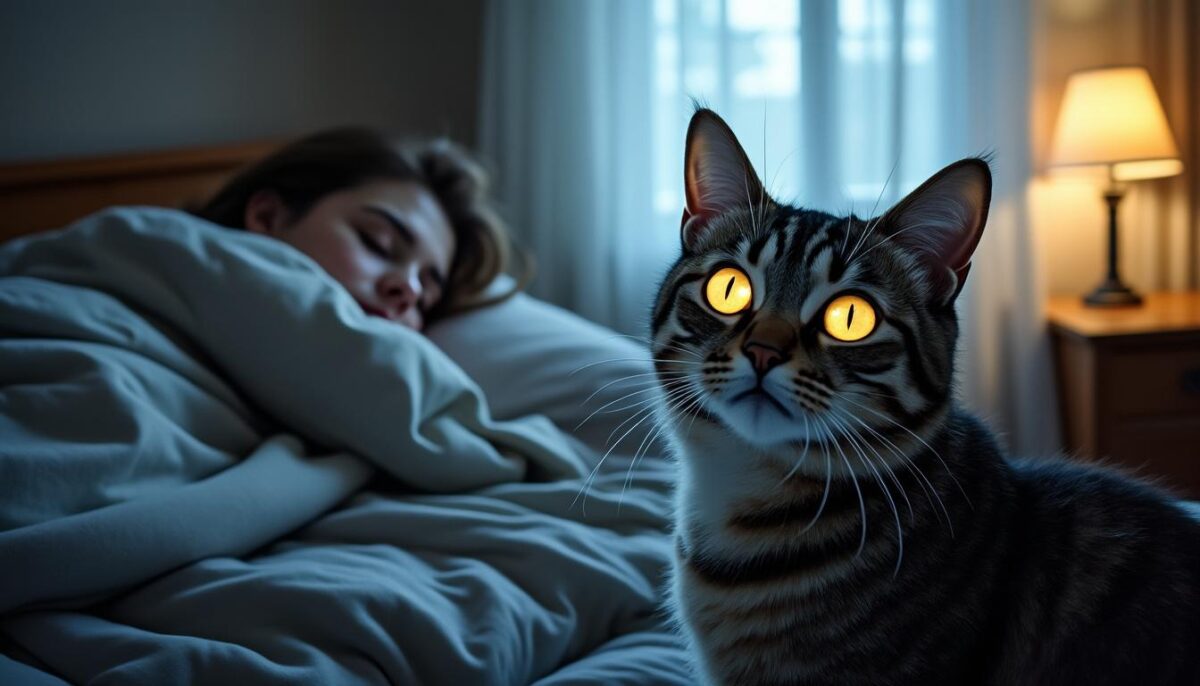
Your cat watches you while you sleep
Hi everyone, Judith here. Your cat may watch you sleep because it’s awake, intrigued by a movement, or waiting for company or food. That look alone doesn’t prove that it’s protecting you or detecting a problem. To understand what’s going on, focus especially on the time, its posture, and what it does next.
Cats often have bursts of activity at dawn and dusk, and their sleep is spread across several periods. Their rhythm may therefore differ from yours. A calm cat near the bed doesn’t necessarily need intervention; new awakenings accompanied by restlessness, meowing, or disorientation call for more attention.
Compare this look with its other ways of interacting: you can read why a cat becomes clingy or why it turns its back on you. These observations complement each other, but they don’t let you read its mind.
The link between feline instincts and watching you while you sleep
Being active more often at dusk or dawn explains why a cat might move around while you sleep. A noise, movement under the covers, or a mealtime habit may catch its attention. This doesn’t prove that it has a protective mission: several motivations are possible.
- Exceptional night vision: Their ability to distinguish shapes and movements in the dark is remarkable, allowing them to watch you even in low light.
- Acute hearing: They perceive sounds that are imperceptible to us, picking up subtle clues in their surroundings.
- Sensitive whiskers: These fine detectors reveal the slightest changes in the air, alerting them to any unusual disturbance.
Fictional example: every morning, a cat stares at its human and then heads to the kitchen. If it gets its meal as soon as the human gets up, this sequence may be a learned expectation. Another cat watches for a few seconds and then lies back down: the same behavior doesn’t mean the same thing.
| Instinct | Description | Why it matters |
|---|---|---|
| Night vision | Vision adapted to low light, not absolute darkness | Allows it to detect certain movements |
| Acute hearing | Perception of inaudible sounds | A noise may catch its attention |
| Sensitive whiskers | Detection of changes in the air | Helps it explore its immediate surroundings |
Observant behavior: curiosity, companionship, or waiting
Staying close may be part of your relationship, but a look alone isn’t enough to measure affection. Notice whether your cat lies back down, asks for interaction, heads to its food bowl, or watches a noise. Avoid staring back at it for a long time or provoking reactions to test it.
- Drawn to your movements: Involuntary movements during sleep intrigue cats.
- Possibly waiting: Notice what follows the look: a meal, play, or a return to resting.
- Building a bond: This silent contact strengthens mutual trust.
If your cat wakes you by playing with your feet, offer appropriate play before bedtime rather than using your hands or playing under the covers. Keep strings and small objects it could swallow out of reach.
Your cat’s extraordinary sensory perception at night
Your cat may notice your movements and faint sounds during the night. These abilities don’t let it know for certain how you feel. Its vision works well in low light, but not in total darkness, as Cats Protection explains in its article about cat vision.
- Vision: Detects shapes in the dark
- Hearing: Reacts to faint, quiet noises
- Smell: Identifies changing scents associated with your presence
- Whiskers: Analyze the immediate surroundings
| Sensory ability | Function at night | Impact on the relationship |
|---|---|---|
| Vision | Seeing shapes and movements | Active watching even in low light |
| Hearing | Perceiving faint sounds | Reacting to certain noises in the room |
| Smell | Analyzing scents | Maintaining a reassuring bond through scent |
| Whiskers | Detecting wind and air movements | Exploring nearby obstacles |
These senses explain why a change in the room may alert your cat. Don’t conclude that a simple fixed stare reveals a human illness or that your cat thinks your sleep is dangerous.
Distinguish what you observe from what you assume
Describe the facts before interpreting them: “it’s by the bed at 5 a.m., looks at me, then meows at the door” is more useful than “it’s watching over me.” Note whether this behavior is longstanding or new, and whether it depends on mealtimes or noises.
- Position: note whether it stays at a distance, comes close, or lies back down.
- Body language: Observe micro-movements and postures.
- Changes: Look for a sudden change, restlessness, or unusual meowing.
| Observation | What to check | Practical response |
|---|---|---|
| Stillness | Is the cat relaxed or tense? | Leave it in peace if everything is as usual |
| Micro-movements | Is it watching your feet or the door? | Avoid playing with your hands and feet |
| No noise | Does it lie back down on its own? | Keep an accessible resting place available |
Building and preserving your bond with your cat at night
For calmer nights, spread out interactions and activities when your cat is naturally awake. Don’t force it to stay awake during the day. A consistent bed, a clean litter box, and accessible water help it manage on its own during the night.
- Respect its needs: Provide several accessible, quiet places to rest.
- Maintain a calm routine: Help it wind down before night with play or cuddles.
- Notice changes: Note restlessness, meowing, disorientation, appetite, and litter box habits.
If waking and meowing start suddenly, especially in an older cat, ask a vet to examine it before concluding that it’s bored. A change in thirst, weight, appetite, or litter box habits is also worth mentioning.
A simple routine if your cat wakes you
1. Offer a short, appropriate play session when it’s awake, then help it wind down before you go to bed. 2. Keep its daily food allowance measured; if hunger seems to be a factor, discuss splitting it into smaller meals or using a timed feeder. 3. Note the times it wakes and any related signs to see what changes, without punishment or depriving it of sleep.
The RSPCA suggests gradual adjustments to play, meals, and the environment, after ruling out a medical cause. If the problem persists, ask for guidance tailored to your cat.
Why does my cat watch me while I sleep?
It may simply be awake, drawn to a movement, or waiting for interaction. The look alone doesn’t tell you whether it’s protecting you or reveal its intentions.
Is it a sign of affection?
Being close may be part of a familiar relationship, but a fixed stare alone isn’t proof of love. Observe its posture and the context.
Does this mean my cat is worried?
Not necessarily. Compare it with your cat’s usual behavior; new behavior accompanied by restlessness or disorientation warrants veterinary advice.
How can I help my cat sleep better at night?
Creating a calm environment, sticking to its mealtimes, and playing with it in the evening may help it sleep.
Is my cat waking me because it has insomnia?
Not necessarily: its activity rhythm may differ from yours. New awakenings or ones accompanied by unusual signs warrant an examination, rather than an at-home diagnosis of insomnia.
Thanks for stopping by; Judith