
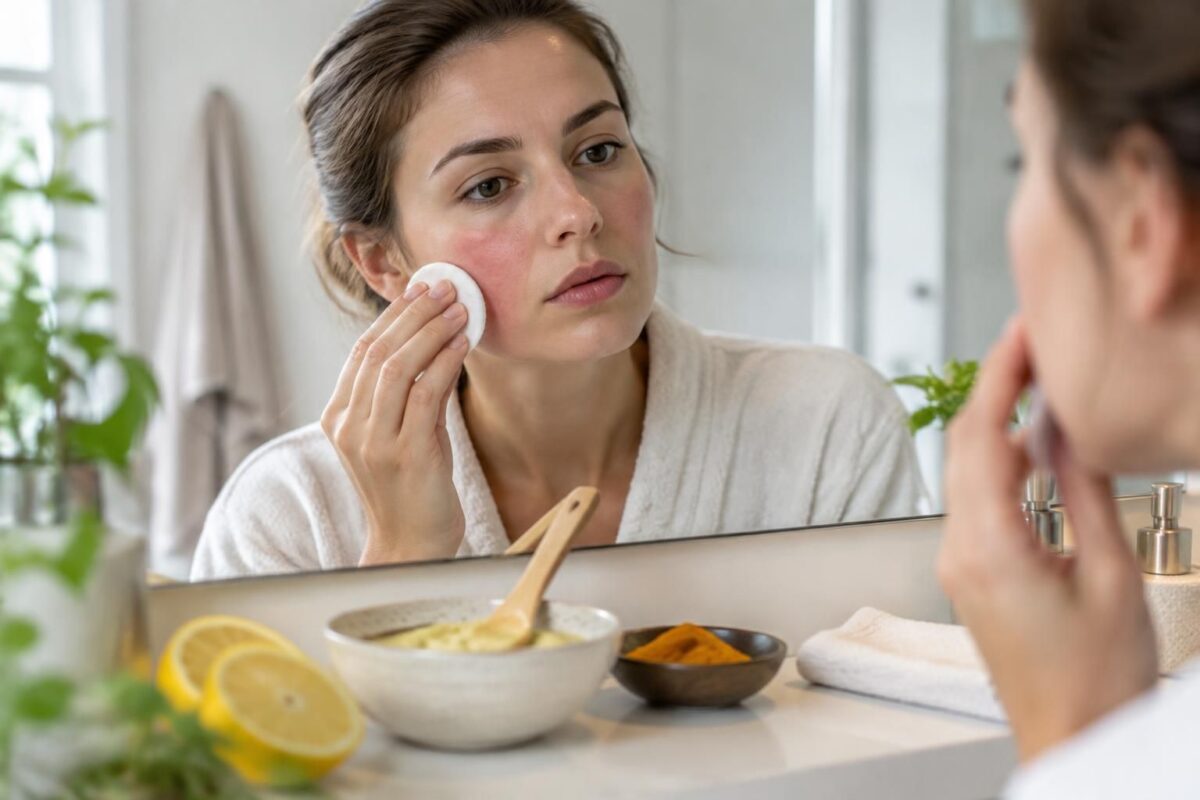
Gentle product? These at-home treatments aren’t.
Hi, I’m Judith.
A mask made in your kitchen or a cream enriched with essential oils may seem gentler than a store-bought product. However, natural ingredients can irritate the skin, cause allergic reactions, or become contaminated during preparation. For safer homemade skincare, it’s best to keep things simple and avoid harsh recipes.
Homemade skincare: the simple answer to avoiding irritation
Natural doesn’t mean gentle. Lemon juice, baking soda, and some essential oils can weaken the skin barrier, especially if your skin is dry, reactive, or prone to eczema. A popular recipe isn’t necessarily right for your face.
Three habits can already make a real difference: avoid irritating ingredients, maintain strict hygiene, and choose gentle, fragrance-free products. If your skin burns or turns red, rinse immediately and stop using the product.
Do this now: 5 sensible steps
- Keep lemon juice and baking soda out of facial recipes.
- Don’t add essential oils to a cream without knowing the precautions for use.
- Wash your hands and utensils before preparing anything.
- Make small amounts and throw away a mixture if its smell, color, or texture changes.
- Test any new product carefully on a small area of non-irritated skin, then monitor for a reaction.
To identify ingredients that deserve special attention, you can read these tips about a common product that shouldn’t be used in homemade skincare and discover simple ways to soothe your skin without overdoing your skincare.
Why some natural remedies irritate the skin
The skin doesn’t react only to whether an ingredient is “natural.” Its concentration, how often it’s applied, and your skin’s sensitivity matter too. A fragrance or essential oil can therefore trigger skin irritation or allergic reactions in some people.
Lemon and baking soda are often presented as easy remedies, but they aren’t harmless facial treatments. Exfoliating acids such as glycolic acid or lactic acid can also irritate reactive skin if they’re not chosen carefully or are used too often.
| Ingredient or category | Why to be cautious | Gentler option |
|---|---|---|
| Lemon juice, baking soda | They can irritate the skin and disrupt its balance. | A gentle cleanser designed for the face. |
| Fragrances, essential oils, lavender | They can trigger irritation or an allergic reaction, especially on sensitive skin. | A fragrance-free moisturizer. |
| Menthol, camphor, witch hazel | The cooling sensation or astringent effect can make discomfort worse. | A simple formula without a “tingling” effect. |
| Exfoliating acids and alcohol | They can dry out or irritate some reactive skin. | A short routine suited to your skin’s tolerance. |
A preparation containing water may also keep for less time than you think. At home, it’s difficult to control preservation the way a professional manufacturer can: make small amounts, and don’t keep a mixture if its appearance or smell changes.
Gentle products to choose for reactive skin
When your skin feels tight, turns red, or itches, the best approach is often a short routine. A gentle cleanser without exfoliating ingredients, a fragrance-free cream, and suitable sun protection may be enough to limit irritating steps.
Creams with ceramides or colloidal oatmeal may suit some people with dry, sensitive skin. A simple petroleum jelly-based ointment can also help seal in moisture on very dry areas. For sun protection, mineral formulas with zinc oxide or titanium dioxide may sometimes be better tolerated, but no formula can guarantee that there will be no reaction at all.
Common mistake: thinking a tingling sensation means it’s working
A product that makes your skin feel hot, sting, or turn red isn’t necessarily working. These sensations can signal irritation, especially after applying menthol, alcohol, or exfoliating acids.
Imagine Léa trying a lemon mask after exfoliating her face. If redness appears, she doesn’t add another recipe to “fix” it: she rinses, stops using active ingredients, and goes back to a simple cream. If you have persistent pain, swelling, or a severe reaction, ask a healthcare professional for advice.
Three steps to get back to a stress-free routine
- Take a break. Stop using homemade recipes and any products that cause discomfort.
- Keep it simple. Use a gentle cleanser, a fragrance-free cream, and sun protection if you go outside.
- Reintroduce products carefully. Add just one product at a time and observe your skin before trying another.
Practical questions about homemade skincare
Is baking soda gentle on the face?
Not necessarily. It can irritate the skin and isn’t a facial exfoliant to use without caution.
Are essential oils safe because they’re natural?
No. They can cause skin irritation or an allergic reaction. Some people, including pregnant women, also need to follow specific precautions.
Which products should I choose if I have sensitive skin?
Start with a short routine: a gentle cleanser, a fragrance-free moisturizer, and suitable sun protection. If symptoms persist, ask a healthcare professional for advice.
Does testing a product on a small area guarantee that I won’t have an allergic reaction?
No. It can help identify an immediate reaction, but it doesn’t guarantee that no reaction will occur later.
Thanks for reading, Judith. Feel free to leave a comment if you’d like to share your thoughts or experience.