
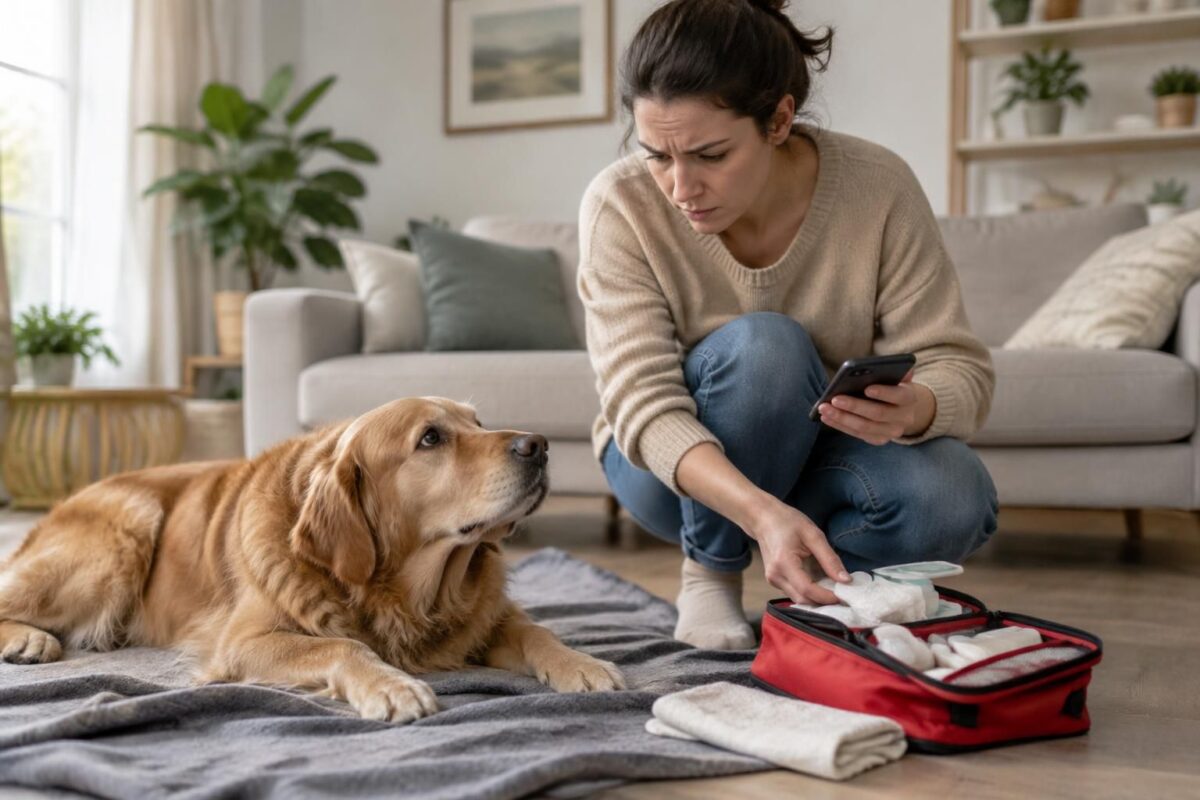
Animal first aid : the doubt that wastes time
Hi, I’m Judith. In case of emergency, call a veterinarian without delay and apply only the simple steps that do not risk worsening your animal’s condition. Doubt and hesitation waste time: secure the area, observe the urgent signs and seek veterinary advice. First aid for animals is meant to stabilize your companion, not to replace a consultation.
What to do right away
- Keep the animal away from danger : traffic, heat, cold or a suspicious substance.
- Approach it calmly and protect yourself: pain can trigger a bite, even from a gentle animal.
- Check if it responds and breathes, without shaking it or moving it unnecessarily.
- Call your veterinarian or veterinary emergency services and describe the symptoms.
- Do not give any medication and do not make it vomit without professional guidance.
Keep these reflexes in mind: a quick intervention often starts with a call, not with a complicated gesture. To prepare your reactions, also consult the proper order of the first steps and the products you should never give to your pet.
Urgency assessment: recognizing the signs that matter
An unconscious animal, one that is having difficulty breathing, bleeding heavily, convulsing, or may have swallowed a toxic product must be treated without delay. Call a veterinary clinic before leaving: they can guide you and prepare its arrival.
Also observe the color of the gums, the breathing and the reaction to your voice, without delaying the call to take action. Very labored breathing, pale or blue-tinged gums and sudden weakness are warning signs.
Three steps to act without panicking
- Step 1 — Secure. Keep away from hazards and approach slowly. If the animal is injured or frightened, keep your face away from its mouth and ask for help to hold it without compressing.
- Step 2 — Call. Provide the species, approximate weight, symptoms, their onset time and the actions already taken. In case of poisoning, keep the packaging or take a photo of the product.
- Step 3 — Transport according to the instructions. Limit its movements, especially after a fall or if a fracture is possible. Do not offer food, water, or medication without veterinary approval.
This method helps avoid a common mistake: spending a long time on the internet while the animal’s condition worsens. The professional can tailor their advice to the species and the situation.
Animal first aid by urgency
| Situation | Immediate action | To avoid |
|---|---|---|
| Suspected poisoning | Call a veterinarian or a veterinary poison control center. Note the product, the time and the possible quantity. | Do not induce vomiting and do not give milk or homemade remedies. |
| Extreme heat | Place the animal in the shade and cool. Gradually wet its paws, belly and neck with cool water, not ice-cold, then call a veterinarian. | Do not plunge it into icy water and do not assume an apparent improvement means recovery. |
| Severe cold and major weakness | Keep it sheltered, dry it if wet, and wrap it in a blanket. Quickly contact a veterinarian. | No direct electric heat or very hot water. |
| Heavy bleeding | Place a clean cloth over the wound and maintain continuous pressure for several minutes, without lifting to check. | Do not remove an object embedded in the wound. |
| Drowning or trouble breathing | Take the animal out of the water without putting yourself in danger and call a veterinary clinic immediately. | Do not suspend the head downward and do not try to expel the water by shaking it. |
For a wound, if the tissue becomes soaked with blood, add another layer on top without removing the first and head to the emergency room. After a drowning incident, a veterinary consultation remains important even if the animal seems to be breathing again: respiratory complications can appear later.
If it’s poisoning… / If it’s heat stroke…
If it’s poisoning… don’t try to neutralize the product. Call your veterinarian or a veterinary poison control center immediately. In France, the numbers for veterinary poison control centers are the CAPV in Lyon at 04 78 87 10 40 and in Paris at 01 40 68 19 00; if you don’t reach them quickly, contact a veterinary clinic on duty.
If it’s a heat stroke… start gradually cooling the animal while you organize its trip to the veterinarian. Even if it seems to be getting better, a professional evaluation is necessary, as internal damage is not always visible right away.
Animal safety: actions to take
First aid is not the same for a dog, a cat, a rabbit, a bird or a reptile. In case of unconsciousness and absence of breathing, immediately ask the veterinarian to guide you: resuscitation depends on the species and size. If you have learned animal CPR, follow your training; otherwise, avoid improvised gestures and focus on calling and transporting.
In case of a convulsion, move objects away from the animal, lower the noise and time the seizure. Do not restrain it and never put your fingers in its mouth. A first seizure, a prolonged seizure, or several seizures in quick succession justify urgent veterinary contact.
Prepare a handy home kit
A ready-to-access kit saves you from searching for bandages at the last moment. It can contain sterile compresses, bandages, adhesive tape, gloves, saline solution, round-tipped scissors and a survival blanket.
- Add the contact details of your regular veterinarian and an on-call clinic.
- Keep the health record and the list of known treatments or allergies within reach.
- Regularly check expiration dates and replace what has been used.
A muzzle can be useful for some dogs, but do not use it if the animal is vomiting, having trouble breathing, or is unconscious. For a cat or a small animal, a transport carrier prepared in advance often makes leaving easier.
FAQ about first aid steps
Should I always call a veterinarian after the first aid steps?
Yes, as soon as it involves a breathing difficulty, a loss of consciousness, poisoning, heavy bleeding, a seizure, or a heat stroke. First aid measures can sometimes stabilize the animal, but they do not replace its examination.
Can I make my animal vomit if it swallowed a product?
No, not without veterinary guidance. Some products, especially corrosive ones, can cause more damage when coming back up. Call quickly and keep the packaging or take a photo of the product.
What should I do if my animal is bleeding?
Place a clean cloth on the wound and maintain continuous pressure for several minutes. Do not remove an embedded object and contact a veterinary clinic if the bleeding is heavy or does not stop.
Should an animal that seems to have recovered after a drowning be seen?
Yes. Respiratory difficulties can appear after the incident, even if the animal seems to be doing better. Call a veterinarian and follow their transport instructions.
Thank you for your interest; Judith. It would be kind to leave me a comment at the end of the article, thanks to everyone