Homemade Dog Food: 3 Ways to Get the Portions Right
Hi, I’m Judith. To get the proportions right for a homemade diet, have a veterinarian create a suitable recipe, weigh every ingredient, and adjust the portions as your dog’s weight changes. A homemade meal can be tasty and varied, but its quantities can’t be worked out using a single rule. A dog’s weight, age, activity level, and health all affect its nutritional needs.
Good habits to adopt
- Ask a veterinarian or canine nutrition specialist to calculate your dog’s portions.
- Weigh the ingredients with a scale, following the recipe instructions.
- Add the prescribed vitamin and mineral supplement; don’t replace it with vegetables.
- Keep an eye on your dog’s weight, body shape, energy, and stools.
- Adjust portions gradually, and ask for advice if your dog’s condition changes.
A well-planned homemade dog diet is not simply one-third meat, one-third vegetables, and one-third starchy foods: this popular rule does not guarantee a nutritionally balanced diet for dogs. To learn how to measure ingredients without guessing, also see these tips on homemade portions without a kitchen scale and the guidance on how to spot a possible nutritional imbalance.
Three ways to measure portions for homemade dog meals
Portioning starts with a precise recipe. You can’t give two dogs of the same weight the same number of grams: one may be very active, while the other may be neutered or prone to weight gain. Here are three complementary ways to work out portions without treating an estimate as a certainty.
1. Start with your dog’s energy needs
The veterinarian estimates daily needs based on your dog’s weight, age, activity level, neuter status, and body condition. Calculating calories gives you a starting point, not a one-size-fits-all portion: two similar dogs may have different needs.
Once the recipe has been formulated, its energy content can be used to convert the target calories into an amount of food. Ingredients must be counted in the state specified by the recipe — raw or cooked — because their weight and water content change during cooking. Don’t apply a formula you find online to your dog without professional approval.
2. Weigh the ingredients and portions
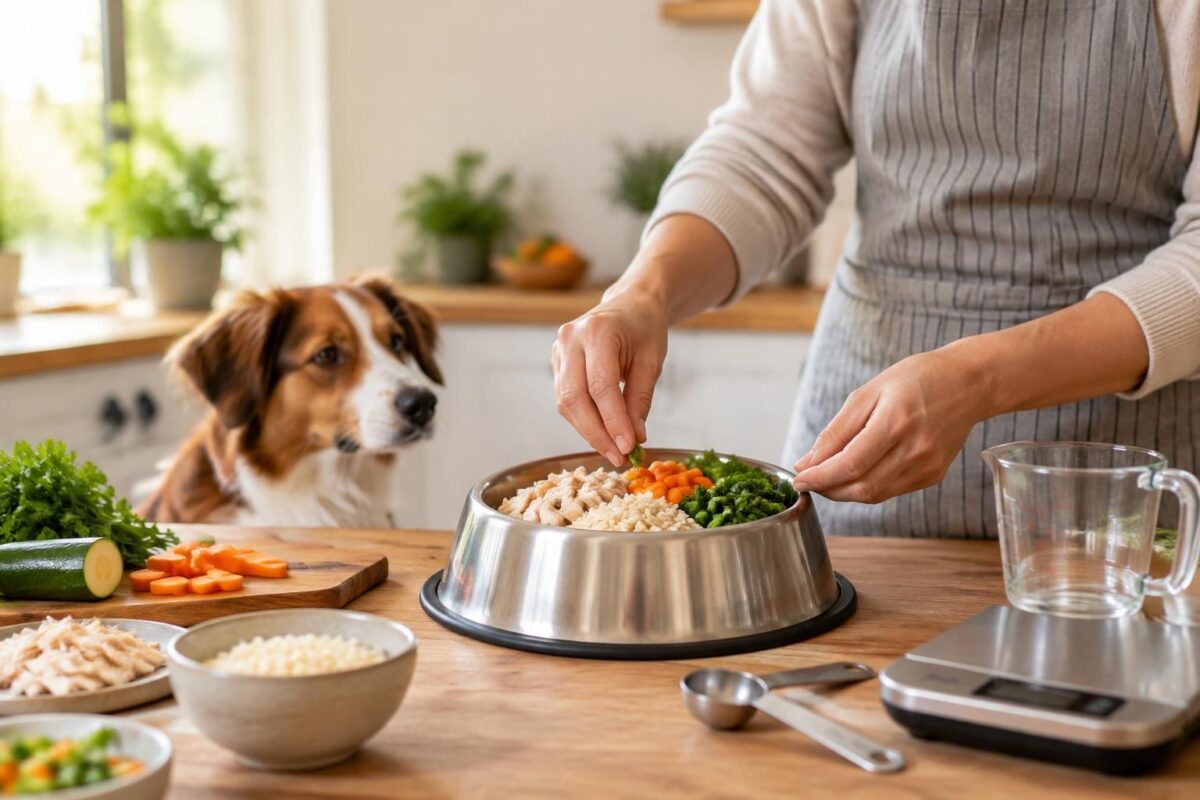
A scale is the easiest way to follow a recipe accurately. Weigh the meat, starchy foods, and vegetables separately, then add the oils and supplement in the prescribed amounts. A spoonful measured “by eye” can make a significant difference, especially with oil, which is very energy-dense.
For example, if the recipe specifies a particular amount of cooked rice, don’t replace it with the same weight of uncooked rice: uncooked rice absorbs water and increases in weight. You can prepare several portions ahead of time, weigh them individually, and store them in suitable containers in the refrigerator or freezer.
3. Check your dog’s body shape and adjust
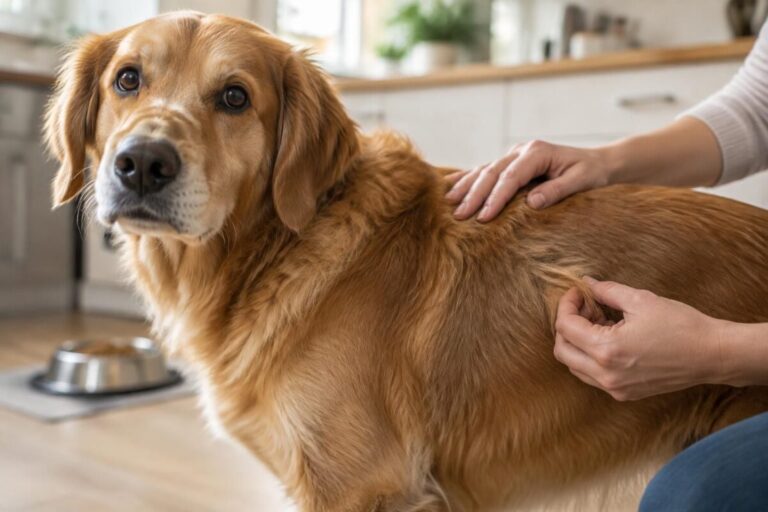
Your dog’s ideal weight can also be assessed by looking at their body shape. As a general rule, you should be able to feel the ribs beneath a thin layer of fat, without them being very visible, and the waist should be discernible when viewed from above. Record your dog’s weight regularly and monitor their appetite, energy, and stool consistency.
If your dog gains or loses weight, don’t suddenly reduce or increase their portions: have the recipe and portions checked. A persistent change may be due to a change in activity, a health problem, or an imbalance in the diet. Monitoring turns portioning into a reasoned adjustment rather than a guess.
What portion sizes alone don’t tell you
A bowl made with good-quality ingredients isn’t necessarily nutritionally complete. Meat, fish, vegetables, and starchy foods don’t always provide enough calcium, vitamins, and trace minerals. A vitamin and mineral supplement suited to the recipe is often necessary; its dose should be calculated with the professional overseeing your dog’s care.
Also avoid table scraps, which are often too salty or seasoned, as well as dangerous foods such as chocolate, grapes, onions, and garlic. Cooked bones should also be avoided. When switching from kibble to homemade food, a gradual transition over several days can help limit digestive upset.
Comparing three approaches to portioning
| Method | What it’s for | Point to watch |
|---|---|---|
| Energy calculation | Estimate daily needs based on your dog’s individual profile | The result must be tailored and approved by a professional |
| Weighing ingredients | Follow the recipe and reproduce the portions accurately | Weigh the food in the state specified, raw or cooked |
| Monitoring body shape | Check that the quantity remains suitable over time | A lasting change in weight warrants veterinary advice |
Set up a portioning routine in three steps
- Have the diet formulated: Give your veterinarian your dog’s weight, age, activity level, medical history, and any specific goals.
- Prepare and weigh: Follow the recipe and supplement instructions, then divide the meals into measured portions.
- Monitor and reassess: Keep an eye on your dog’s weight and body condition, and ask your veterinarian for advice if their needs change.
This routine makes homemade feeding easier to understand and safer. The best portioning method is one that follows a complete recipe and is tailored to the dog in front of you, not a theoretical average.
Frequently asked questions about portioning homemade meals
Can you calculate a dog’s portions using only their weight?
No. Weight provides a reference point, but age, activity level, neuter status, health, and body condition also affect a dog’s needs.
Is the rule of 30 g per kilo suitable for every dog?
No. The energy density and composition of recipes vary considerably. A fixed amount per kilo can therefore lead to overfeeding or an inadequate intake.
Should supplements be added to a homemade diet?
Often, yes. A recipe needs to be balanced for vitamins and minerals, especially calcium. The type and dose of supplement must be determined for the specific recipe.
How often should portions be reassessed?
Monitor your dog’s weight and body shape regularly, and request a reassessment whenever their activity level, age, health, or body condition changes.
Take good care of your companion, and feel free to share your observations in the comments. — Judith